The latest innovation in the China of robot drive axis.
Latest News
Truss Type Robot Manipulator: When Factories Stop Adding Machines and Start Rebuilding Space Logic
Release time:
Jul 22,2026
In many factory automation upgrades, there is a recurring misunderstanding:
production bottlenecks are often blamed on “insufficient robots.”
So the natural reaction is to add more equipment.
But once engineers step into the workshop, a different reality usually appears—the real limitation is not robot capability, but how production space has been fragmented into disconnected zones.
This is where the Truss Type Robot Manipulator starts to make sense—not as a stronger robot, but as a system that reorganizes industrial space itself.
The Real Problem Is Not Automation, But Fragmented Layouts
In traditional production lines, layouts often look like this:
- One machine equals one fixed workstation
- Robots operate within a limited radius
- Workpieces are constantly moved between stations
- Each process exists as an isolated “island”
On paper, this looks like automation. In reality, it is a broken spatial system.
This leads to:
- Low robot utilization
- High material handling cost
- Interrupted production rhythm
- Difficult scalability of the line
The issue is not the machines. It is the spatial logic behind them.
Truss Systems Reconnect Disconnected Production Zones
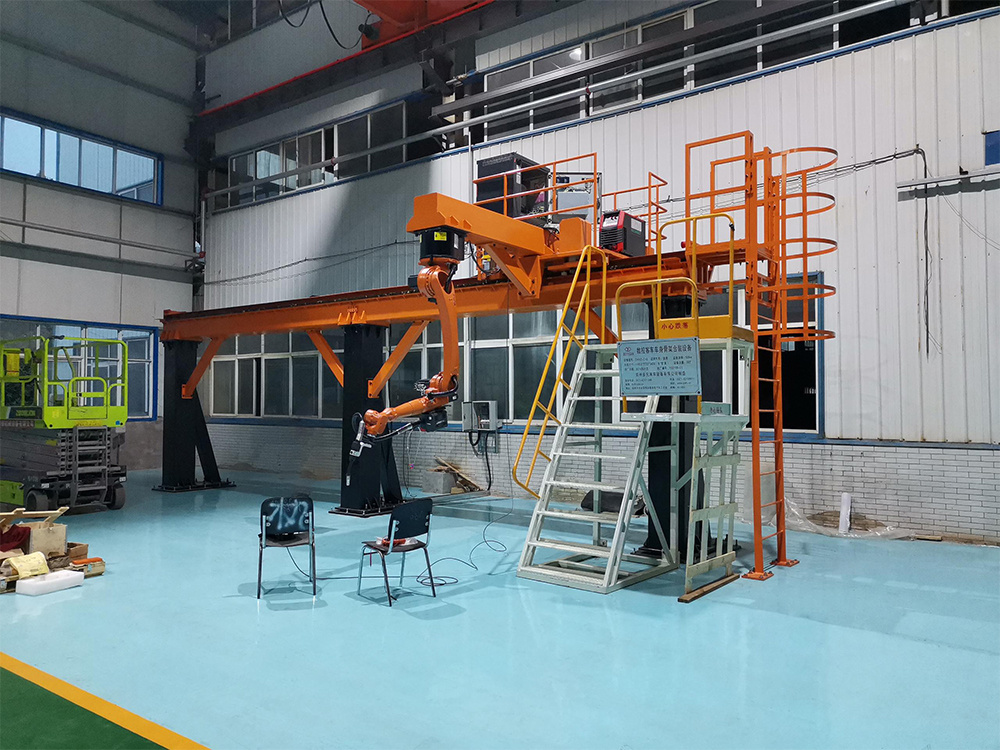
A truss type manipulator does not behave like a robotic arm with joints. Instead, it uses a bridge-like structural frame to extend motion across the factory floor.
The key shift is simple:
Motion is no longer confined to local zones—it happens within one continuous coordinate system.
This changes everything:
- Workstations are no longer “points”
- They become positions along a shared motion path
- Production space becomes continuous instead of segmented
In other words, the factory stops thinking in islands and starts thinking in lines and trajectories.
Robots Stop Standing Still and Start Traveling
Once a truss system is introduced, the most obvious change is not technical—it is visual.
Instead of robots waiting for parts, you see:
robots moving toward tasks.
This changes production behavior in a fundamental way:
- Instead of moving parts to machines, machines move to parts
- Instead of fixed stations, there is a continuous working corridor
- Instead of manual coordination, motion itself synchronizes the process
The production model shifts from station-based thinking to path-based execution.
Why Adding Robots Often Solves Less Than Expected
A common reaction to capacity pressure is to add another robot.
But this approach only increases “points” in the system—it does not fix fragmentation.
Truss systems take a different approach:
- One structure covers multiple zones
- Motion spans across the entire production line
- Multiple stations share a single automation backbone
- Equipment is centralized rather than duplicated
The goal is not more robots—it is fewer disconnected systems.
Structure Is Not Just Support—It Defines Motion Boundaries
At first glance, a truss manipulator looks like a large steel frame. But its function goes far beyond support.
It defines:
where motion is allowed to happen.
Typical structural logic includes:
- Overhead truss beams defining span length
- Linear axes defining travel range
- Vertical modules defining working depth
- Unified coordinate control across the system
This creates a single, coherent motion space instead of multiple independent zones.
What Actually Changes on the Factory Floor
Once a truss system is fully running, the biggest transformation is not parameter optimization—it is process redesign.
Engineers begin to:
- Redefine workflows based on movement paths instead of machines
- Merge previously separated workstations
- Synchronize operations across larger spatial areas
- Shift from batch coordination to continuous flow
At this point, production is no longer “machine-driven.” It becomes space-driven.
Where Truss Systems Make the Most Sense
This architecture is not limited to a specific industry. It becomes valuable wherever space efficiency is a constraint:
- Factories with dense workstation layouts
- Long-distance material transfer requirements
- Multi-machine integrated processing lines
- Production environments limited by floor space rather than demand
In these cases, the real bottleneck is not automation level—it is how poorly space is utilized.
Conclusion
The Truss Type Robot Manipulator is not simply a larger automation device. It represents a shift in thinking—from expanding machine quantity to redesigning spatial logic.
It changes the question from:
“How many robots do we need?”to:“How should production space be structured so fewer systems can do more?”
When automation problems move from equipment level to spatial level, truss systems stop being optional upgrades—they become the foundation of how modern factories organize movement itself.
keywords
Guangzhou Seventh Axis Intelligent Equipment Co., Ltd.
We provide our products with a golden service team, a quick response mechanism, and lifelong follow-up services, so that you can work together without worry.
Xintai Technology Industrial Park, No. 62 Dachong Road, Nansha District, Guangzhou
GET IN TOUCH
Online Message

puenshi

Guangzhou Seventh Axis Intelligent Equipment Co., Ltd.
Tel: 020-83150912
Mobile phone:+86 18998358207
Email: fjx18998358207@dqzrobot.cn
Address: Xintai Technology Industrial Park, No. 62 Dachong Road, Nansha District, Guangzhou