The latest innovation in the China of robot drive axis.

Latest News
Industrial Robot Motion System: Turning Factory Movement into a Coordinated Automation Infrastructure
Release time:
Jul 29,2026
In modern manufacturing, robots are no longer evaluated only by payload or speed. The real challenge has shifted toward something more fundamental: how to organize motion across an entire production system. This is where the Industrial Robot Motion System becomes essential—not as a single machine, but as a coordinated architecture that defines how robots move, position, and interact within a factory environment.
Instead of treating motion as a function of one robot, industries are now treating it as a system-level design problem.
The Core Issue: Robots Are Fast, but Factories Are Still Disconnected
On paper, industrial robots are highly capable:
- High repeatability
- Precise multi-axis control
- Strong payload handling
- Programmable motion paths
But in real production environments, a different limitation appears.
Most factories are still built around isolated motion zones:
- One robot per workstation
- Fixed operation radius
- Separate machines with no shared motion logic
- Material movement handled outside robotic control
This creates a hidden inefficiency:
robots are optimized individually, but the factory is not optimized as a whole.
What an Industrial Robot Motion System Actually Means
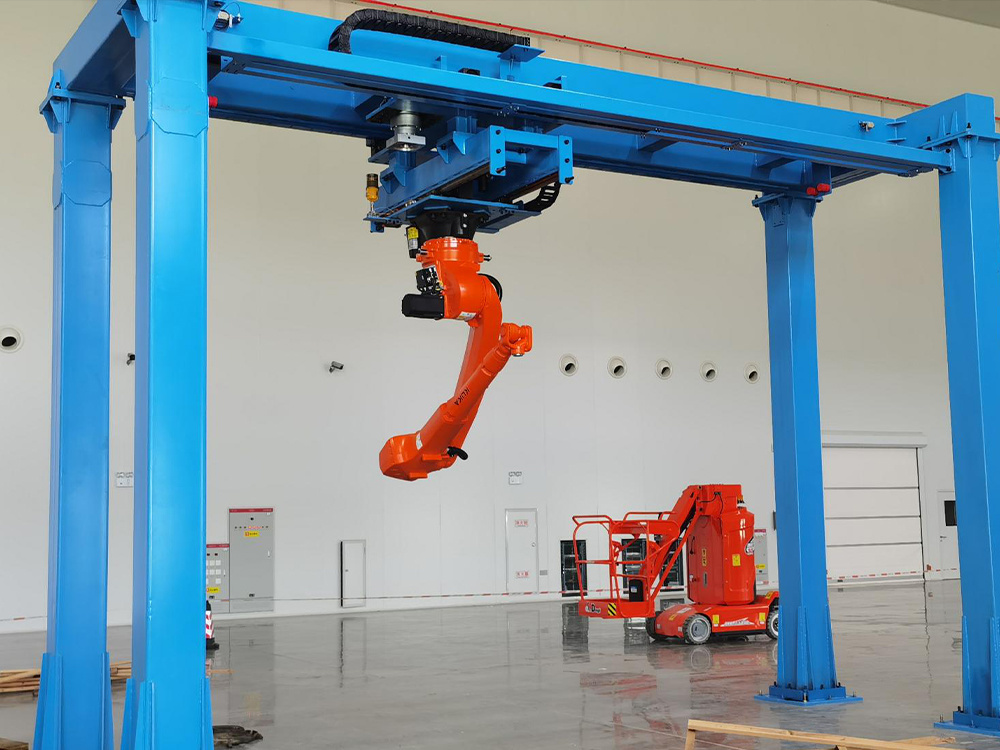
An industrial robot motion system is not just a robot. It is a layered motion architecture that integrates:
- Linear axes (tracks, gantries, floor rails)
- Cartesian or truss structures
- Multi-axis robotic arms
- Servo-driven positioning systems
- Centralized motion controllers
Together, they form a unified system where movement is not local—it is distributed across the production floor.
This allows robots to move beyond fixed positions and become part of a larger spatial control network.
Motion Becomes a Shared Resource, Not a Fixed Capability
In traditional setups, motion belongs to a single robot. In modern systems, motion becomes shared infrastructure.
That means:
- One motion platform can serve multiple robots
- Robots can travel between work zones
- Workstations become dynamic rather than fixed
- Production space becomes programmable
Instead of asking, “What can this robot reach?”
factories now ask, “How should motion be distributed across the system?”
Linear Expansion: The Key to Breaking Fixed Work Envelopes
A major limitation of articulated robots is the fixed work envelope. Once installed, their range is constrained by geometry.
Industrial robot motion systems solve this through linear expansion mechanisms, such as:
- Floor track systems
- Gantry structures
- Truss-type frames
- External axis extensions
These systems effectively turn a stationary robot into a mobile industrial unit, allowing it to operate across multiple stations instead of a single point.
This is especially critical in large-scale manufacturing environments where parts are oversized or processes are distributed.
System-Level Synchronization: The Real Engineering Challenge
Adding movement is not enough. The real complexity lies in synchronization.
An industrial robot motion system must coordinate:
- Robot joint movement
- External axis motion (tracks or gantries)
- Tool operation timing
- Workpiece positioning
- Safety boundaries across shared space
When these elements are properly synchronized, motion becomes continuous and predictable rather than segmented.
This is what enables:
- Seamless long-distance welding
- Multi-station pick-and-place
- Continuous machining operations
- Synchronized assembly workflows
Why Factories Are Moving Toward Motion Systems Instead of Single Robots
The shift is not about replacing robots—it is about restructuring how robots are used.
Factories adopt motion systems because they want:
- Fewer isolated machines
- More shared automation infrastructure
- Better utilization of expensive robotic assets
- Flexible production line reconfiguration
- Reduced material handling between stations
In this model, the robot is no longer the center of automation.
The motion system is.
Conclusion
The Industrial Robot Motion System represents a shift in automation thinking—from optimizing individual machines to designing coordinated motion across entire factories.
Instead of asking how powerful a robot is, modern manufacturing asks something more important:
How does motion flow through the production system?
When this question becomes the design foundation, robots stop being isolated tools and become part of a larger, engineered movement ecosystem that defines how modern factories operate.
keywords
Guangzhou Seventh Axis Intelligent Equipment Co., Ltd.
We provide our products with a golden service team, a quick response mechanism, and lifelong follow-up services, so that you can work together without worry.
Xintai Technology Industrial Park, No. 62 Dachong Road, Nansha District, Guangzhou
GET IN TOUCH
Online Message

puenshi

Guangzhou Seventh Axis Intelligent Equipment Co., Ltd.
Tel: 020-83150912
Mobile phone:+86 18998358207
Email: fjx18998358207@dqzrobot.cn
Address: Xintai Technology Industrial Park, No. 62 Dachong Road, Nansha District, Guangzhou