The latest innovation in the China of robot drive axis.
Latest News
Robot Floor Track: Expanding Industrial Robot Mobility for Smarter and More Efficient Automation
Release time:
Aug 05,2026
A professional Robot Floor Track provides an effective solution by allowing industrial robots to move along a linear path, greatly expanding their working range and improving production flexibility
In today's rapidly developing manufacturing industry, industrial robots have become an essential part of automated production. However, many traditional robot systems are limited by fixed installation positions, making it difficult to handle large workpieces, extended production lines, or multi-station operations efficiently.
A professional Robot Floor Track provides an effective solution by allowing industrial robots to move along a linear path, greatly expanding their working range and improving production flexibility. By combining precise mechanical transmission with stable structural design, robot floor tracks help manufacturers maximize robot utilization, reduce equipment investment, and build more efficient automated production systems.
Designed for applications such as welding, material handling, assembly, and flexible manufacturing lines, robot floor tracks are becoming an important component in modern industrial automation.
Overcoming the Limitations of Fixed Robot Installation
Although industrial robots provide excellent repeatability and automation capabilities, fixed-position robots often face limitations in large-scale manufacturing environments.
Common production challenges include:
- Limited robot working area
- Difficulty reaching multiple processing stations
- Increased number of robots required for large projects
- Low flexibility when production layouts change
- Higher investment costs for automation upgrades
For industries such as automotive manufacturing, metal fabrication, and heavy equipment production, these limitations can reduce overall production efficiency.
A Robot Floor Track solves these problems by adding an additional linear movement axis, allowing one robot to serve multiple working positions while maintaining high precision and stability.
How Robot Floor Track Improves Industrial Automation
A robot floor track works as an extended movement platform for industrial robots, enabling them to travel horizontally along a predefined path.
Instead of installing multiple robots in different locations, manufacturers can use one robot combined with a floor track system to cover a wider production area.
The main benefits include:
- Expanded robot operating range
- Improved production line flexibility
- Reduced equipment investment
- Better utilization of existing robots
- Easier integration with automated systems
This makes robot floor tracks especially valuable for factories seeking higher efficiency without significantly increasing equipment costs.
Precision Structure for Stable Robot Movement
For industrial automation, movement accuracy is critical. Any vibration or positioning error can affect welding quality, assembly accuracy, and production consistency.
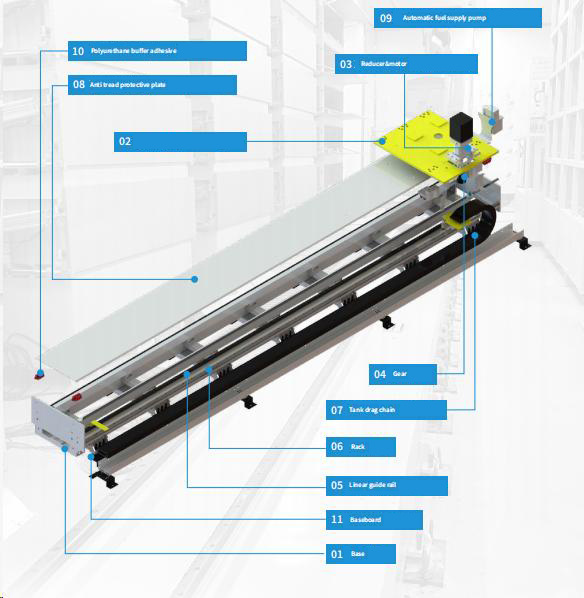
A high-quality Robot Floor Track is designed with a strong mechanical structure and precise transmission system to ensure reliable operation.
Key features include:
- High-strength steel structure for heavy loads
- Precise linear movement control
- Stable operation during long production cycles
- Wear-resistant components for extended service life
- Smooth robot positioning and repeatability
These design advantages allow robots to maintain consistent performance even in demanding industrial environments.
Wide Applications Across Modern Manufacturing
The versatility of Robot Floor Track systems makes them suitable for various industrial applications.
Typical applications include:
Robotic Welding
Large welding projects often require robots to reach different areas of oversized workpieces. A floor track allows welding robots to move smoothly along production lines, improving welding coverage and efficiency.
Material Handling
In logistics and manufacturing environments, robot floor tracks help robots transport materials between different stations, reducing manual handling requirements.
Automotive Production
Automotive factories use robot movement systems to support flexible production lines, including body welding, component assembly, and automated processing.
Heavy Industry Manufacturing
For large structures and equipment, extended robot movement capability helps improve processing efficiency while reducing the need for multiple robotic systems.
DQZ Robot provides customized seventh-axis solutions designed for industrial automation applications, including flexible production lines, automobile production, logistics systems, and robot mobile platforms.
Robot Floor Track Helps Reduce Production Costs
Automation investment is not only about purchasing equipment but also about improving long-term production efficiency.
A properly designed Robot Floor Track can help manufacturers reduce costs through:
- Lower robot quantity requirements
- Reduced manual operation
- Improved production continuity
- Less equipment replacement
- Higher productivity per robot system
By increasing the working range of existing robots, companies can achieve greater automation results with fewer resources.
Robot Floor Track vs Fixed Robot Installation
Feature | Fixed Robot System | Robot Floor Track System |
Working Range | Limited | Expanded |
Production Flexibility | Lower | Higher |
Robot Utilization | Standard | Improved |
Large Workpiece Processing | Difficult | Easier |
Equipment Investment | Higher for large areas | More Efficient |
Automation Expansion | Limited | Flexible |
For manufacturers dealing with large components or complex production layouts, robot floor tracks provide a more practical automation approach.
Why Manufacturers Choose Professional Robot Floor Track Solutions
Modern factories require automation equipment that is reliable, flexible, and adaptable to future production needs.
A professional Robot Floor Track offers:
- Extended robot working capability
- High positioning accuracy
- Strong load capacity
- Stable long-term operation
- Flexible production integration
- Reduced automation costs
With customized design options, manufacturers can select suitable track structures according to robot models, production environments, and application requirements. DQZ Robot specializes in robot seventh-axis equipment and customized robot walking mechanisms designed to improve production efficiency and reduce manufacturing costs.
Conclusion
As industrial automation continues to evolve, improving robot flexibility has become a key focus for manufacturers.
A Robot Floor Track transforms a fixed robot into a mobile automation solution, allowing factories to expand production capabilities, optimize workflows, and improve overall efficiency.
Whether used for welding, handling, assembly, or large-scale manufacturing applications, robot floor tracks provide a reliable way to maximize robot performance and create smarter production environments.
For companies looking to upgrade automation systems and achieve higher productivity, investing in a high-quality robot floor track is a practical step toward the future of intelligent manufacturing.
keywords
Guangzhou Seventh Axis Intelligent Equipment Co., Ltd.
We provide our products with a golden service team, a quick response mechanism, and lifelong follow-up services, so that you can work together without worry.
Xintai Technology Industrial Park, No. 62 Dachong Road, Nansha District, Guangzhou
GET IN TOUCH
Online Message

puenshi

Guangzhou Seventh Axis Intelligent Equipment Co., Ltd.
Tel: 020-83150912
Mobile phone:+86 18998358207
Email: fjx18998358207@dqzrobot.cn
Address: Xintai Technology Industrial Park, No. 62 Dachong Road, Nansha District, Guangzhou